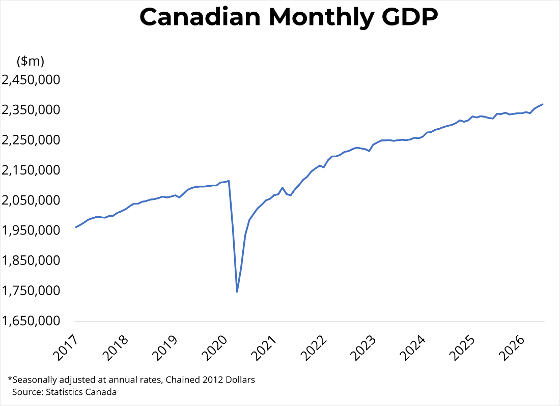
Canadian real GDP rose by 0.3 per cent in June, after growing by 0.3 per cent in May. Goods-producing industries contracted by 0.1 per cent, offset by 0.4 per cent growth in service-producing sectors. Sectoral growth was led by wholesale trade (1.7 per cent), retail trade (1.4 per cent), and manufacturing (0.6 per cent). Meanwhile, the biggest detractor to growth was the mining, quarrying, and oil and gas extraction sector (-0.6 per cent). Output for the offices of real-estate agents and brokers rose by 0.6 per cent month-over-month. Preliminary estimates suggest that real GDP by industry was largely unchanged in July.
Real GDP increased by 0.8 per cent in the second quarter of 2026, registering an annualized growth rate of 3.3 per cent. Growth was driven by a resurgence in exports, which rose by 3.6 per cent, the largest increase since Q1 2023. Household consumption continued to strengthen, rising by 0.8 per cent in Q2, driven by higher spending on investment services that outpaced drawdowns in gasoline and food expenditure. Growth in total capital investment (1.5 per cent) was largely attributable to strong business investment growth (2.3 per cent). Looking deeper, investment into both residential and non-residential structures rose by 2.5 and 2.9 per cent, respectively. The household savings rate rose to 3.7 per cent, as disposable income growth outpaced nominal spending growth by 0.4 percentage points on the back of wage increases and higher government transfers.
Canada’s economic performance in Q2, coupled with an upward revision to growth in the previous quarter, will dispel previous fears of a prolonged technical recession. Annualized quarterly growth reached its highest level since Q3 2024, outperforming the Bank of Canada’s projection of 2.5 per cent. Sharp export recoveries spearheaded growth, as exports to both the US and the rest of the world have steadily risen over recent months. Household spending remained resilient, while business investment comfortably outpaced a decrease in government investment. Taken together, final domestic demand grew by 1 per cent in the second quarter, the largest quarterly increase since Q4 2024.
Looking ahead, economic headwinds continue to intensify, as seen by recent trade escalations and new tariffs between Canada and the US. Moreover, a breach in the Iran ceasefire at the end of July means continued inflationary pressure as oil prices remain significantly elevated. Altogether, the Canadian economy will have to continue demonstrating similar resilience in Q3 to reach or surpass the Bank’s projection of 1.5 per cent growth. Overall, we expect the Bank to hold its policy rate through this year. However, this report, along with encouraging signs in the labour market, is slightly biasing toward eventual rate hikes in 2027, which markets continue to expect.
For more information regarding British Columbia’s GDP growth, please visit our Nowcast for an estimate of economic activity throughout the province:
BCREA Nowcast - British Columbia Real Estate Association
 The data relating to real estate on this website comes in part from the MLS® Reciprocity program of either the Greater Vancouver REALTORS® (GVR), the Fraser Valley Real Estate Board (FVREB) or the Chilliwack and District Real Estate Board (CADREB). Real estate listings held by participating real estate firms are marked with the MLS® logo and detailed information about the listing includes the name of the listing agent. This representation is based in whole or part on data generated by either the GVR, the FVREB or the CADREB which assumes no responsibility for its accuracy. The materials contained on this page may not be reproduced without the express written consent of either the GVR, the FVREB or the CADREB.
Comments:
Post Your Comment: