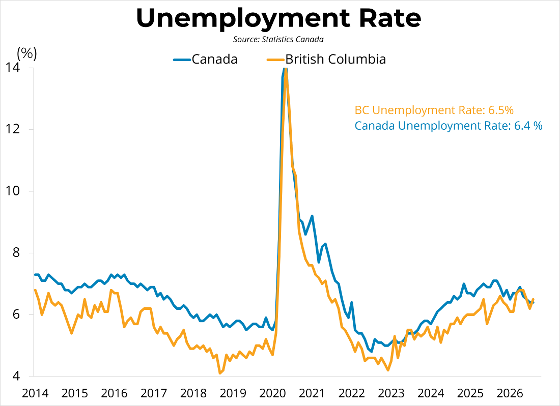
Canadian employment declined from the previous month, with the economy losing nearly 42,000 jobs (-0.2 per cent) to 21.173 million in August. The employment rate fell 0.1 points to 60.8 per cent, while the unemployment rate was unchanged at 6.4 per cent. Average hourly wages rose 2 per cent year-over-year to $37.02 in August.
Employment in B.C. decreased by 0.2 per cent to about 2.949 million, with the provincial economy losing about 5,500 jobs in August. Employment in Metro Vancouver rose by 0.7 per cent to 1.719 million. The unemployment rate in B.C. rose by 0.3 points to 6.5 per cent, while Vancouver's unemployment rate rose by 0.5 points to 6.5 per cent in August.
August’s jobs report gave back some of the employment gains recorded over the previous three months, demonstrating the volatility that has challenged the labour market over the past few quarters. Despite relatively consistent drawdowns across different sectors in August, the Canadian economy still added over 50,000 jobs on a cumulative basis over the summer, climbing into positive territory year-to-date with July’s strong report. Resilience in the labour market since February and a resurgent second-quarter economy are biasing toward eventual rate hikes from the Bank of Canada, which has held its policy rate at 2.25 per cent since October 2025. Further, the persistence of the Iran conflict and its oil price shock along with new bilateral tariffs with the US cast inflationary pressure on the economy. Taken together, we expect monetary policy to remain unchanged this year, before the Bank raises its policy rate in 2027 toward its neutral level of 2.75 per cent.
 The data relating to real estate on this website comes in part from the MLS® Reciprocity program of either the Greater Vancouver REALTORS® (GVR), the Fraser Valley Real Estate Board (FVREB) or the Chilliwack and District Real Estate Board (CADREB). Real estate listings held by participating real estate firms are marked with the MLS® logo and detailed information about the listing includes the name of the listing agent. This representation is based in whole or part on data generated by either the GVR, the FVREB or the CADREB which assumes no responsibility for its accuracy. The materials contained on this page may not be reproduced without the express written consent of either the GVR, the FVREB or the CADREB.
Comments:
Post Your Comment: