
Housing Monitor Dashboard - January 29, 2026
Vancouver, BC – January 28, 2026. The British Columbia Real Estate Association (BCREA) released its 2026 First Quarter Housing Forecast Update today.
Multiple Listing Service® (MLS®) residential sales in BC are forecast to rise 12 per cent to 78,690 units this year. In 2027, MLS® residential sales are forecast to move higher, rising 4.8 per cent to 82,450 units.

“Despite some resilience against global uncertainty, both the economy and housing market struggled through 2025,” said BCREA Chief Economist Brendon Ogmundson. “However, with mortgage rates expected to remain steady and significant pent-up demand following over two years of below-average activity, we expect demand to steadily come off the sidelines to strengthen home sales this year.”
With inventory running near its highest level in over a decade – just over 40,000 homes for sale across the province – price growth should be tempered as markets are expected to remain balanced in 2026. We anticipate the average price in BC will rise roughly three per cent in 2026 to $982,800, up from $953,314 in 2025. This increase will largely reflect composition effects, as the sales recovery in higher-priced markets in the Lower Mainland catches up to the rest of the province.
To view the full interactive BCREA Market Intelligence report, click here.
To view the latest Market Intelligence report PDF, click here.
Vancouver, BC – January 26, 2026. The latest economic report from the BC Real Estate Association (BCREA) indicates that immediate government action is required to encourage housing starts and avoid rapid home price increases toward the end of this decade.
According to a new BCREA Market Intelligence report, today’s housing market shows signs similar to the 2010s housing cycle, which ultimately led to severe undersupply and a dramatic deterioration in affordability.
Summary of Findings
Policy action on both demand and supply sides is needed now, including measures to strengthen pre‑sales, reconsider foreign‑buyer participation in new construction, and reduce development costs. Without this, BC is likely to enter another prolonged affordability crisis.

“Unsold inventory of new homes is rising to levels not seen since the late 1990s, which, along with crippling taxes, is discouraging future development,” says BCREA Chief Economist Brendon Ogmundson. “This puts BC at risk of chronic undersupply when demand inevitably returns and a repeat of the 2010s cycle of accelerating home prices.”
The report concludes that expanding supply remains the most important ingredient to both sustainable development and moderated price growth over the foreseeable future, while also noting that there is substantial benefit to reducing the existing excess of unsold new inventory as quickly as possible.
Canadian retail sales increased by 1.3 per cent to $70.4 billion in November compared to the previous month. Compared to the same time last year, retail sales were up by 3.1 per cent. Furthermore, core retail sales, which exclude gasoline and automobile items, increased by 1.6 per cent in November. In volume terms, adjusted for rising prices, retail sales rose by 1.1 per cent in November.
Retail sales in British Columbia were up 1.8 per cent in November month-over-month and rose by 4.2 per cent compared to the same time last year. In the CMA of Vancouver, retail sales were up 0.4 per cent from the prior month and were 1.7 per cent above the level of November 2024.
A strong November print made up for two consecutive monthly declines in consumer spending, bringing Canadian retail sales to its highest point of the year. This recovery reflects broader volatility in monthly retail activity throughout 2025 while demonstrating ongoing resilience in consumption despite a relatively weak economy. Markets anticipate a rate hold from the Bank of Canada next week to kick off what is expected to be a quieter year concerning monetary policy adjustments.


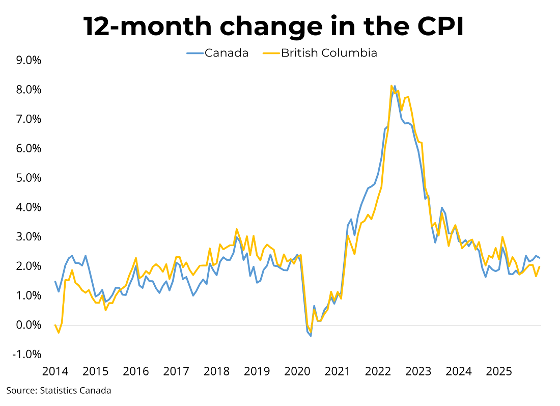
Canadian prices, as measured by the Consumer Price Index (CPI), rose 2.4 per cent on a year-over-year basis in December, following the 2.2 per cent increase in November. On a seasonally adjusted monthly basis, the CPI was up 0.3 per cent in December, equivalent to a 3.7 per cent increase on an annualized basis. The CPI ex-gasoline increased by 3.0 per cent in December, up by 0.4 points from the previous month. Additionally, food prices increased by 6.2 per cent year-over-year, driven by base-year effects from last year’s tax break on restaurant food and continued acceleration in grocery prices. In BC, consumer prices rose 1.7 per cent year-over-year in December, down 0.5 points from November’s increase. The Bank of Canada's preferred measures of median and trimmed inflation, which strip out volatile components, fell to 2.5 and 2.7 per cent year-over-year, respectively.
Much of the upward pressure in December’s CPI print was a base-year effect from last year’s GST/HST holiday on several aggregates, counteracted by larger declines in gasoline prices. Nonetheless, 3-month annualized core inflation cooled to about 1.65 per cent, its lowest level since Spring of 2024, and falling below the midpoint of the Bank of Canada’s threshold. Looking ahead, we expect a rate-hold from the Bank next week as they further evaluate Canada’s economic growth in the final quarter relative to their most recent projections.

Vancouver, BC – January 19, 2026. The Association of Interior REALTORS® (AOIR), in partnership with the British Columbia Real Estate Association (BCREA), is renewing calls for the federal government to exempt several major ski resort communities in the province from 2022’s Prohibition on the Purchase of Residential Property by Non-Canadians Act (also known as the Foreign Buyer Ban).
Under current federal regulations, the Foreign Buyer Ban applies to areas designated by Statistics Canada as Census Metropolitan Areas (CMAs) or Census Agglomerations (CAs). In BC’s Interior, this classification captures nine communities and their surrounding regions. While the legislation aims to curb foreign speculation in major population centres, using CMA and CA boundaries as the determining factor has inadvertently swept up a number of geographically distinct areas.
Specifically, the Foreign Buyer Ban has caused unintentional economic difficulties for some ski communities. In already challenging market conditions, preventing foreign investment in tourism-focused areas is a needless hindrance. Yet despite federal awareness of this issue, the government has been slow to act.
“Another year has gone by and we’ve yet to see any action on this,” said AOIR Director of Government Relations and Communications Seth Scott. “The Interior has some of the province’s most important tourism regions and most popular ski hills. Homes on these mountains serve a different purpose than those in the centre of communities. With another ski season underway, now is the time for government to step up with an exemption and keep these areas economically viable in an already challenged economy.”
Currently, the Foreign Buyer Ban doesn’t encompass other large BC ski resort areas and municipalities, including Whistler and Big White, or other ski communities outside the province, such as Mont Tremblant.
“This is a matter of fairness and consistency,” said BCREA Senior VP of Government Relations, Marketing & Communications Trevor Hargreaves. “Including some ski resort areas and excluding others simply by chance really isn’t good policy making. Providing an exemption for all ski communities in BC is a simple fix and the right thing to do. This is an urgent issue, and it’s one that Canada’s Minister of Housing and Infrastructure, Gregor Robertson, should get to work on fixing immediately.”
AOIR and BCREA are urging Housing, Infrastructure and Communities Canada as well as the Canada Mortgage and Housing Corporation to issue a regulatory exemption for Sun Peaks, Apex Mountain, SilverStar, and similar Interior ski resort areas as soon as possible.
Canadian housing starts increased 11 per cent from the previous month, totaling 282,439 units in December at a seasonally adjusted annual rate (SAAR).Starts were up 21 per cent from the same month last year (SAAR). In areas with 10,000 or more residents, single-detached housing starts decreased by 14 per cent year-over-year, while multi-family and other starts increased by 35 per cent compared to December 2024.
In areas of British Columbia with 10,000 or more residents, starts were up by about 2 per cent from last December to 39,189 units (SAAR). In these urban areas, single-detached starts increased by 4 per cent, while multi-family starts rose by 1 per cent year-over-year. In 2025, year-over-year starts were up by 80 per cent in Abbotsford and 16 per cent in Victoria, but down by 56 per cent in Nanaimo, 31 per cent in Kelowna, and 3 per cent in Vancouver.


|
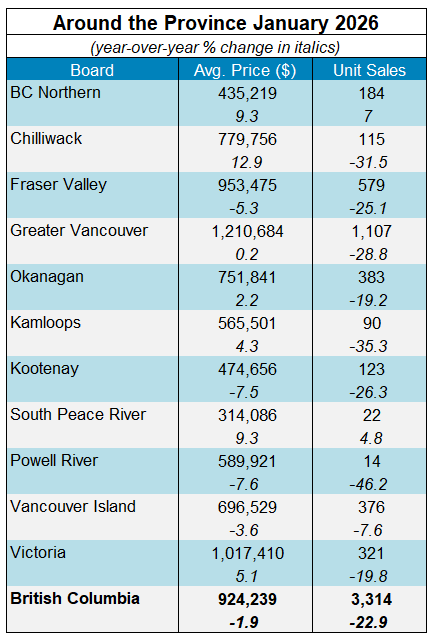
Vancouver, BC – January 13, 2026. The British Columbia Real Estate Association (BCREA) reports that 4,271 residential unit sales were recorded in Multiple Listing Service® (MLS®) Systems in December 2025, down 5.9 per cent from December 2024. The average MLS® residential price in BC in December 2025 was down 5.6 per cent at $952,061 compared to $1,008,513 in December 2024. |

Total MLS® residential sales dollar volume was $4.1 billion, down 14.5 per cent from the same time the previous year. BC MLS® unit sales were 18.5 per cent lower than the ten-year average for the month of December.
“Weakness in provincial market activity was concentrated in the Lower Mainland in 2025, with sales across the province recovering at different rates from tariff uncertainty,” said BCREA Chief Economist Brendon Ogmundson. “Looking ahead, we hope that steady mortgage rates and fading trade uncertainty with the US will strengthen demand, leading to a broader recovery in the housing market.”
Year-to-date, BC residential sales dollar volume is down 8.3 per cent to $67 billion, compared with the same period in 2024. Residential unit sales are down 5.6 per cent year-over-year at 70,255 units, while the average MLS® residential price is also down 2.9 per cent to $953,345.
Fatigue is rarely only about sleep. More often, it stems from how your body manages energy through blood sugar, hydration, and hormones. When those systems fall out of rhythm, even a full night’s rest can leave you drained.
Blood sugar and hormones. When you skip meals or eat foods low in protein and fiber, your blood sugar can drop quickly. The body releases cortisol to compensate, which helps raise glucose but increases stress on your system. Eventually, elevated cortisol can interfere with insulin sensitivity and worsen energy swings. Studies published in The Journal of Clinical Endocrinology and Metabolism and Diabetes Care show that unstable blood sugar is strongly linked to fatigue, mood changes, and reduced alertness.

Hydration and brain function. The brain is nearly 75% water, and research in the Journal of Nutrition shows that even mild dehydration can impair focus, short-term memory, and coordination. A 2023 study in BMC Medicine found that consistent hydration supports healthy brain aging and reduces feelings of mental fatigue over time.
Energy balance and recovery. When blood sugar fluctuates or hydration drops, your nervous system perceives stress. Energy is redirected toward survival functions, leaving less of it for clarity, focus, and stamina. Research in Frontiers in Human Neuroscience highlights that short recovery breaks, steady hydration, and balanced meals help the body return to its natural energy rhythm.
What helps. Start the day with protein and fiber to stabilize glucose. Sip water steadily through the morning. Step outside or stretch after meals to support circulation. And recharge your mind via short pauses between tasks.
Sometimes tiredness isn’t about needing more, it’s about doing less, with intention. When your body feels balanced, your energy does, too.
Some days you sit down to work, and everything flows. However, during other days, you struggle to focus, and your brain will not cooperate. The difference might be with your environment, not you.
Environmental psychology studies how our surroundings impact our emotion and behavior. Levels of light, sound, scent, and even clutter influence the brain’s chemistry.

Research in the Journal of Environmental Psychology shows that bright, natural light can boost serotonin and alertness; dim, warm light promotes calm and creativity.
Clutter has been linked to higher cortisol levels, the body’s stress hormone, which can quietly drain motivation over time.
The spaces we inhabit cue our brains about which kind of energy to bring. A clear desk signals focus, whereas a cozy corner invites rest. Even small sensory details—such as the sound of soft music, the smell of citrus, or the feel of a weighted mug—can shift your mood within minutes.
This month, take ten minutes to audit your environment and then open a window, clear your workspace, and add a plant or candle. Tiny changes can create the conditions for big motivation and remind you that the space you build around yourself can be the first step toward the energy you bring into the world.
Cooking at home saves money and changes how your body processes food. When you prepare a meal, you slow your mind and engage your senses, which trigger what scientists call “cephalic phase digestion.” This is the brain’s signal to the gut that food is coming. Enzymes and stomach acid start to flow, which helps your body digest more easily and absorb nutrients better.

Home cooking also gives you control. Restaurant meals often contain more salt, oil, and sugar than your body needs. Cooking your own food means using fresher ingredients and healthier fats, which maintain blood sugar and support gut balance.
Studies in Public Health Nutrition show that people who cook most of their meals at home eat fewer calories and maintain a healthier weight over time. You do not need to cook elaborate dishes; simple meals made with care are enough.
Cooking isn’t only about which foods you put on the plate; it’s a way to slow down, become aware, and nourish yourself inside and out.
Call or Email me today and let's discuss your next home sale or purchase.
 The data relating to real estate on this website comes in part from the MLS® Reciprocity program of either the Greater Vancouver REALTORS® (GVR), the Fraser Valley Real Estate Board (FVREB) or the Chilliwack and District Real Estate Board (CADREB). Real estate listings held by participating real estate firms are marked with the MLS® logo and detailed information about the listing includes the name of the listing agent. This representation is based in whole or part on data generated by either the GVR, the FVREB or the CADREB which assumes no responsibility for its accuracy. The materials contained on this page may not be reproduced without the express written consent of either the GVR, the FVREB or the CADREB.