RSS

A privacy fence can completely change how a yard feels. It can create a quiet space to relax, give pets and kids room to play, and add a sense of comfort and separation from nearby homes. When choosing one, the biggest question usually comes down to this: do you want to spend less now, or spend less time maintaining it later?

Wood fencing is a longtime favorite and often the most affordable way to add privacy. It has a warm, natural look that fits beautifully with many homes and gardens. The tradeoff is maintenance. Over time, wood can weather, fade, or warp, so it usually needs staining or painting and occasional repairs to keep it looking its best. With regular care, however, a wood fence can last for many years. Many homeowners also appreciate that wood can be easily customized with different stains, paints, and styles.

Composite fencing is another option that combines wood fibers with recycled materials to create a strong, durable fence. It offers the look of wood but requires far less maintenance since it does not rot or splinter the same way natural wood can. Composite fencing can be more expensive upfront, but many people like it because it keeps its appearance for years with very little upkeep.

Vinyl fencing has become popular for people who prefer a low maintenance option. It typically costs more upfront, but once it is installed there is very little work required. Vinyl does not rot, warp, or attract insects, and a quick rinse with the hose every so often usually keeps it looking clean. The only downside is that if a section is damaged, repairs can sometimes be a little more complicated.

Aluminum fencing is another option, although it is more commonly seen in decorative or picket style designs rather than full privacy fences. It is strong, lightweight, and naturally resistant to rust, which makes it a good choice in coastal or humid areas. Aluminum fencing comes in a variety of colors and styles, but installation is usually best handled by professionals, and it may not always work as well on uneven ground.

At the end of the day, the best fence is the one that fits both your lifestyle and your yard. Thinking about how much time you want to spend on upkeep in the future can help make the choice a little easier.

Read

Fitness trackers can be great motivators. They count steps, track activity, monitor heart rate, and celebrate when you reach a goal. For many people, that small nudge helps encourage healthier routines and keeps daily habits on track.

But it is easy to start focusing too much on the numbers.

Sport psychology expert Michele Kerulis of Northwestern University notes that becoming overly focused on health metrics can sometimes cause people to ignore the natural signals their bodies are sending.

This summer, remember to enjoy your walks, bike rides, and time outdoors. Your fitness tracker can offer helpful reminders, but how you feel and the joy of moving matter most.

Read

Parrots are known for their intelligence and strong social nature. According to National Public Radio, these birds thrive on interaction, stimulation, and communication, which is one reason they form such strong bonds with their human families.

Researchers recently explored an interesting new way to give parrots even more opportunities to socialize. In an experiment involving 18 parrots, owners trained their birds to ring a small bell whenever they wanted to start a video chat with another parrot participating in the study.

When a parrot rang the bell, the owner held up a tablet or phone showing photos of the other birds. The parrots then used their beaks or tongues to select the companion they wanted to call. The calls allowed the birds to interact and communicate with each other in real time.

Researchers initially wondered if the birds might respond aggressively. Instead, the parrots seemed excited to connect. According to The New York Times, many quickly developed favorite companions and regularly asked for calls. During their chats they sang, danced, groomed, and even mirrored each other’s movements, behaviors commonly seen among parrots in groups in the wild.

Scientists say more research will help better understand the long-term benefits of video calls for birds. Even after the study ended, some parrots still continue to call their feathered friends for a visit.

Read

By July, the garden has found its rhythm. The early planting and patient waiting of spring give way to full color, warm sunshine, and the simple pleasure of watching flowers return year after year. Perennials are the quiet heroes of summer gardens. Once established, they come back each season stronger and fuller, bringing dependable beauty with every passing year.

Dianthus, often called “pinks,” are a classic favorite. Their soft fragrance and delicate blooms make them perfect for cottage-style gardens and small summer bouquets. They are a reminder that sometimes the smallest flowers bring the most charm.

Daylilies are another July standout. Blooming in shades of yellow, peach, red, and orange, they thrive in the summer heat. Each flower lasts only a day, but the plant produces so many that the garden always feels full of life and color.

For bold summer energy, Blanket Flower brings fiery shades of red and gold that attract butterflies and other pollinators. It thrives in sunny gardens and keeps blooming through the warmest days of the season.

Phlox adds height, fragrance, and soft clusters of color that draw birds and butterflies alike. On warm evenings, its gentle scent is one of the simple pleasures of midsummer.

A perennial garden is more than a collection of plants. It reflects patience, care, and the belief that something beautiful will return if given the chance to grow. Year after year, these flowers remind us that the best things in life often come back stronger and brighter with every season.

Read

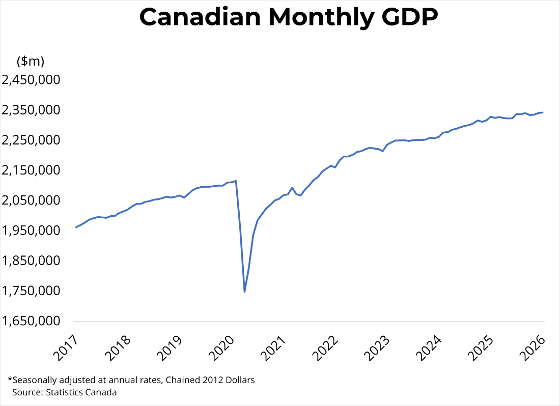
Canadian real GDP grew by 0.5 per cent in April after decreasing by 0.1 per cent in March. Goods-producing sectors rose by 1.2 per cent, while service-producing industries rose by 0.3 per cent from the previous month. Industry contributors to growth were led by mining, quarrying, and oil and gas extraction (2.9 per cent), transportation and warehousing (0.9 per cent), and construction (0.7 per cent). Output for the offices of real-estate agents and brokers rose by 1.3 per cent month-over-month. Preliminary estimates suggest that real GDP by industry increased by 0.1 per cent in May.

April’s rebound in Canadian GDP was an encouraging sign of a growing economy following two consecutive quarters of contraction. Growth was fairly broad-based, with 14 out of 20 sectors expanding from the previous month. Taken together, this print marks the largest monthly increase in GDP by industry since July 2025, which, paired with a positive preliminary estimate for May, is setting the Canadian economy up for a solid rebound in the second quarter of 2026. Despite the strength of this report, it is unlikely to sway the Bank of Canada off its course. We expect the policy rate to remain at 2.25 per cent through 2026 as the Bank continues looking through the double-sided risks facing the economy in favor of anchoring expectations at current levels.  

Read

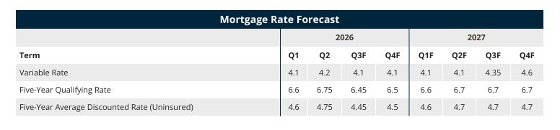
To view the full interactive BCREA Mortgage Rate Forecast, click here.
Download the full report (PDF)

Highlights:

  • Canadian fixed mortgage rates are climbing as the oil price shock persists.
  • Global conflict and trade uncertainty are pushing growth and inflation in opposite directions.

The Bank of Canada remains resolute amidst double-sided risks.

Read

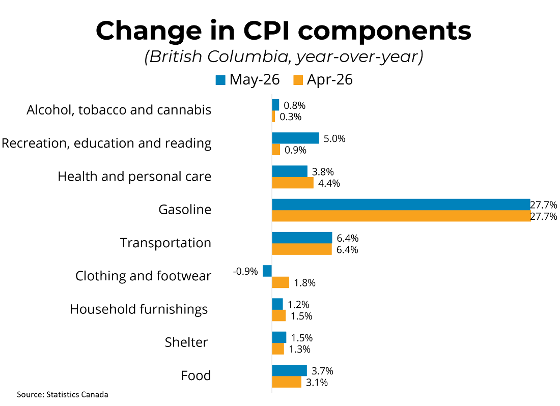
Canadian prices, as measured by the Consumer Price Index (CPI), rose 3.2 per cent on a year-over-year basis in May, following a 2.8 per cent increase in April. On a seasonally adjusted monthly basis, the CPI was up 0.5 per cent in May, equivalent to a 5.9 per cent increase on an annualized basis. The CPI ex-gasoline increased by 2.2 per cent in May, up from 2.0 per cent in the previous month. Additionally, food prices overall increased by 3.8 per cent year-over-year, up from 3.5 per cent in April. In BC, consumer prices rose 2.9 per cent year-over-year in May, up from 2.5 per cent the month prior. The Bank of Canada's preferred measures of median and trimmed inflation, which strip out volatile components, remained at 2.1 per cent and 2.0 per cent year-over-year, unchanged from April. 
 
May’s print comes as no surprise, with upward pressure on headline inflation being driven by higher gasoline prices from the ongoing supply shock stemming from the Iran conflict. However, prices also rose across some non-volatile components, with the CPI excluding gasoline climbing from the previous month. Moreover, 3-month annualized core inflation has risen over the past few months to 2.3 per cent, above the Bank of Canada’s desired target of 2 per cent. Nonetheless, we largely expect the Bank to continue looking through the oil price shock and hold its policy rate at 2.25 per cent through 2026 as they hope for growth to retrace towards their projections in the second quarter.

Read

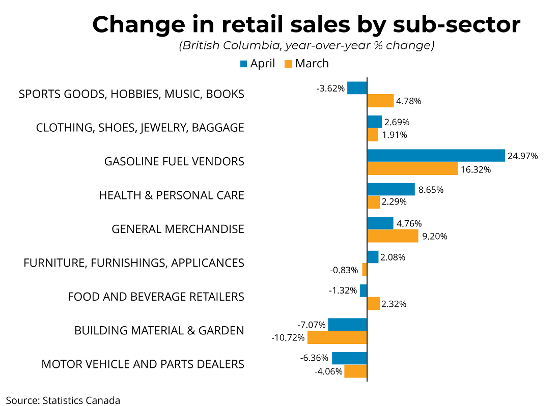
Canadian retail sales increased by 0.5 per cent to $73 billion in April compared to the previous month. Retail sales were 3.7 per cent higher compared to the same time last year. However, core retail sales, which exclude gasoline and automobile items, decreased by 0.7 per cent in April. In volume terms, adjusted for rising prices, retail sales were largely unchanged in April.


Retail sales in British Columbia were up 1.0 per cent in April month-over-month and rose by 1.4 per cent compared to the same time last year. In the CMA of Vancouver, retail sales were up 0.8 per cent from the prior month and were 1.7 per cent below the level of April 2025.

April’s report marks the fourth consecutive month of retail sales growth, demonstrating consistent momentum in consumer spending that we hope translates into the labour market and broader economy over the summer. With discussions of a potential peace agreement in Iran underway, the Bank of Canada may shift focus towards the downside risks facing Canada over the coming months. That said, the volatility between both sides of the conflict warrants caution over the certainty of these discussions. Nonetheless, we expect the Bank of Canada to hold its policy rate at 2.25 per cent at its next meeting, as we remain hopeful for a strong GDP report for April following two quarters of negative growth.

Read

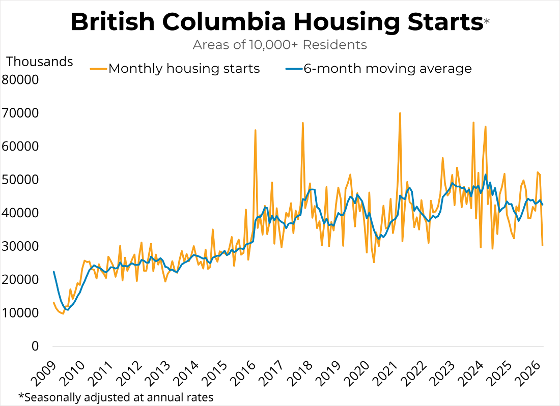
Canadian housing starts decreased 6 per cent from the previous month, totaling 261,377 units in May at a seasonally adjusted annual rate (SAAR).Starts were down 6 per cent from the same month last year (SAAR). In areas with 10,000 or more residents, single-detached housing starts were largely unchanged year-over-year, while multi-family and other starts decreased by 6 per cent compared to May 2025

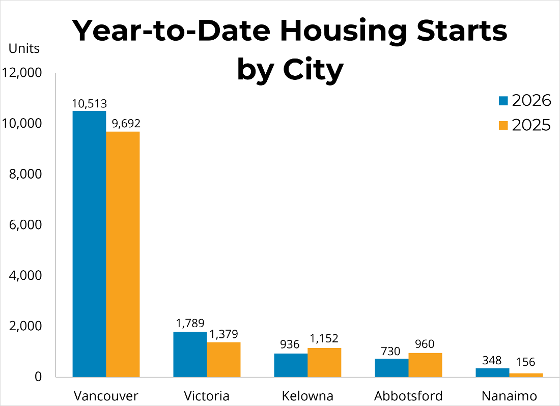
In British Columbia, starts fell by 34 per cent from last month to 38,219 units (SAAR) in all areas of the province. In areas of the province with 10,000 or more residents, single-detached starts increased by 24 per cent to 3,891 units, while multi-family starts fell by 38 per cent to 32,042 units month-over-month (SAAR). Starts in the province were 2 per cent below the levels from May 2025 (SAAR). Year-to-date starts are up 123 per cent in Nanaimo, 30 per cent in Victoria, and 8 per cent in Vancouver, but down 24 per cent in Abbotsford and 9 per cent in Kelowna.

Read

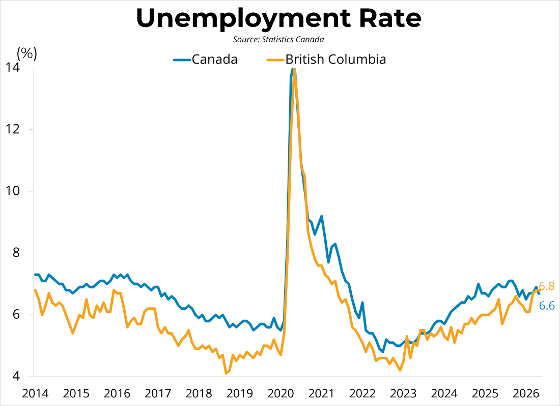
Canadian employment saw a major upswing from the previous month, with the economy gaining 88,000 jobs (+0.4 per cent) to 21.122 million in May. The employment rate rose by 0.2 points to 60.7 per cent, while the unemployment rate fell by 0.3 points to 6.6 per cent. Average hourly wages rose 3.0 per cent year-over-year to $37.24 in May.
           
Employment in B.C. increased by 0.9 per cent to about 2.929 million, with the provincial economy gaining over 25,000 jobs in May. Employment in Metro Vancouver also rose by 0.9 per cent to 1.692 million. The unemployment rate in B.C. held steady at 6.8 per cent, while Vancouver's unemployment rate fell by 0.6 points to 6.4 per cent in May. 

May’s jobs report was a sight for sore eyes for a Canadian labour market that had cumulatively lost over 100,000 jobs over the previous four months. Crucially, the private sector added 56,000 jobs in May, the largest monthly increase since last October. Moreover, the unemployment rate moderated back to 6.6 per cent, unwinding most of the upward pressure seen through the first third of the year. Altogether, this report, albeit very strong, muddies the waters for the Bank of Canada in light of two consecutive quarters of negative growth. It’s worth noting that even with May’s upswing in employment, Canada has still lost more jobs than it has gained on a cumulative basis in 2026, continuing a trend of sharp monthly volatility in the labour market. Nonetheless, we expect another rate hold later this month, as the Bank has set a precedent for caution against policy adjustments as they try balancing the double-sided risks facing the economy.

Read

You may be ready to stop renting and buy a home if your income is stable, your debt is manageable, and you expect to stay in the same area for the next several years. Renting can offer flexibility, but buying may make sense when you are ready for more stability, greater control over your living space, and the ongoing costs of ownership.

Key Takeaways

  • Stable income and manageable debt are strong signs you may be ready to buy.
  • Buying makes more sense when you plan to stay in the same area for several years.
  • Homeownership can offer more control, but it also comes with ongoing costs.
  • Mortgage payments may help you build equity, depending on the market and loan structure.
  • Before you stop renting, review your lease, credit, pre-approval, and upfront costs.

5 Signs You’re Ready to Stop Renting

If you are thinking about moving from renting to owning, the decision usually comes down to timing, finances, and lifestyle. These five signs can help you decide whether you may be ready to stop renting and start preparing to buy a home.

1. You Have a Stable Income

If your income is stable for the next few years, that’s a strong sign you’re financially ready to buy a home. In Canada, most banks require at least 2 years of employment in the same field. If you’re self-employed, lenders typically require two years of tax returns showing consistent income.

2. You Plan to Stay in the Same Area

Renting gives you the freedom to move when your lease ends. But if you see yourself living in your current area for the next three to five years, that flexibility loses its value. Homeownership makes more sense when you’re ready to settle down and build roots in a community.

3. You Want to Start Building Equity

Rent does not build ownership for the renter. When you buy a home, part of each mortgage payment may reduce your loan balance, which can help you build equity over time. That equity may become a useful financial asset if you refinance, sell, or use it later, depending on market conditions and your mortgage structure.

4. You Want More Control Over Your Living Space

You may be tired of waiting for a landlord to fix problems or of asking for permission to make basic changes, like painting a wall. You might want to adopt a pet or renovate the kitchen without restrictions. There’s also the constant worry that your landlord could sell the property or move in themselves. Owning your home gives you control over your living space and long-term security.

5. You Have a Manageable Debt and a Down Payment Plan

You don’t need to be completely debt-free to buy a home in Canada. Lenders look at your Total Debt Service ratio to confirm your monthly debt payments, combined with your housing costs, don’t exceed a certain percentage of your income.

If you have paid down high-interest debt and have a plan to save for a down payment, you may be closer to buying than you think. In Canada, the minimum down payment is 5% for homes priced at $500,000 or less. For homes above $500,000, buyers typically need 5% on the first $500,000 and 10% on the remaining portion.

How to Buy a Home in Canada

Buying a home in Canada starts with understanding your finances, your timeline, and the steps involved in moving from renting to ownership.

Check Your Credit Score

Many lenders favour stronger credit scores, and a higher score may help you qualify for better mortgage options. If your score is lower, you may still qualify, but your options, rate, or down payment requirements may differ.

Review Your Lease Agreement

Find out how much notice you need to give your landlord before moving out. Notice rules vary by province, lease type, and rental agreement. Check your lease and local tenancy rules before choosing a closing date or move-out date.

Get a Mortgage Pre-Approval

Don’t browse listings without understanding your budget. Meet with a mortgage broker or a bank to get formal pre-approval. This tells you exactly how much you can afford and strengthens your position when making an offer.

Review First-Time Buyer Programs

First-time buyers may also want to review programs such as the First Home Savings Account and the Home Buyers’ Plan. These programs may help eligible buyers save for a down payment or access funds for a qualifying home purchase.

REMAX Canada’s experience with buyers across Canada shows that comparing neighbourhoods, property types, and monthly ownership costs can help buyers find a home that fits their budget without losing sight of their longer-term needs.

Frequently Asked Questions

How do you stop renting in Canada?

To stop renting, start by:

  • Checking whether your finances and timeline are ready for homeownership
  • Reviewing your lease and confirming how much notice you need to give
  • Planning your closing date and move-out date carefully
  • Avoiding a timeline that leaves you paying rent and a mortgage at the same time
  • Deciding where you want to live before starting your home search

Before making the move, make sure you have a stable income, manageable debt, and savings for upfront costs.

Can I buy a home if I still have debt?

Yes, you may still be able to buy a home if your debt is manageable. Lenders will look at your income, monthly debt payments, credit profile, and overall ability to carry housing costs.

Should I get mortgage pre-approval before ending my lease?

Yes. Getting mortgage pre-approval before ending your lease can help you understand your budget and avoid committing to a move before you know what you can afford.

Considering Home Ownership

Stable income, manageable debt, a down payment plan, and a desire for more control over your living space can all be signs that you are ready to explore homeownership. 

Read

Homeownership has long been treated as the milestone: the sign you have settled down and started building real wealth. But today, that decision is more complicated. From what REMAX sees across local markets, higher prices, tighter budgets, and shifting interest rates have many renters weighing flexibility against the long-term potential of homeownership. For many Canadians, going from renting to owning is no longer just a question of when to buy, but how ownership would change their monthly budget and long-term plans. Here are five financial shifts to consider.

Key Takeaways

  • The real cost of owning is bigger than the mortgage payment, with repairs, taxes, insurance, condo fees, and maintenance all affecting affordability.
  • First-time buyer programs can help with the down payment, but they work best when buyers still leave room for closing costs and emergencies.
  • The rent-versus-own decision is local. A market that makes sense in Regina may look very different from one in Toronto or Vancouver.

Your Payment Starts Turning into Equity

When you rent, your payment covers the right to live in the home for that month. When you own, your mortgage payment does two things: part goes toward interest, and part goes toward paying down the loan. The interest is the cost of borrowing. The principal is what slowly builds your equity in the property. That is one of the biggest financial differences between renting and owning, but it is important not to oversell it. Equity is not cash you can spend tomorrow. It is wealth tied up in the home, and you usually access it only by selling, refinancing, or borrowing against the property. For anyone learning how to go from renting to owning, this is one of the key shifts to understand.

Your Home Can Grow in Value, But It Is Still a Long-Term Bet

One reason Canadians are drawn to ownership is the potential for their home to increase in value over time. If the property is your principal residence, that growth may also be tax-efficient when you sell, thanks to Canada’s Principal Residence Exemption. But appreciation is never guaranteed, and real estate does not move in a straight line. Prices can rise, stall, or fall depending on interest rates, local demand, housing supply, and the broader economy. When buying your first house, the bigger advantage often comes from owning long enough to build equity, not from trying to buy at the perfect moment.

Your Housing Budget Gets Less Predictable

Renters may face rent increases, but they are usually not responsible for major repairs. Owners are. When planning to buy a house for the first time, the mortgage payment is only one part of the cost of homeownership. Property taxes, insurance, utilities, condo fees, maintenance, repairs, and occasional big-ticket expenses all need room in the budget. A furnace, roof, plumbing issue, or special assessment can turn into a major cost quickly. That does not mean owning is unaffordable, but it does mean the monthly payment is not the full story. A strong ownership budget includes a repair fund from the beginning.

First-Time Buyer Programs Can Help, But You Need a Plan

Programs such as the First Home Savings Account and Home Buyers’ Plan can help eligible Canadians build or access a down payment. The FHSA offers tax-deductible contributions and tax-free qualifying withdrawals, subject to annual and lifetime limits. The HBP allows eligible buyers to withdraw from their RRSP for a qualifying home purchase, with repayment required over time. These tools can speed up the path to ownership, but they should be used carefully so buyers do not create tax issues or weaken their long-term savings. For those buying their first house, the goal is not only getting into the market, but staying financially comfortable once you are there.

The Right Choice Depends on Your Market

The buy-versus-rent decision looks different across Canada. In higher-priced markets such as Toronto and Vancouver, REMAX notes that prices remain elevated even as some segments soften. That can keep the full cost of owning well above the cost of renting. In more affordable markets such as Saint John, Regina, or Medicine Hat, ownership may be more financially within reach. The key is to compare rent against the full cost of owning a similar home in the same market, including the mortgage, taxes, insurance, condo fees, and maintenance. Local market conditions can make a major difference when going from renting to owning.

Frequently Asked Questions

Is now the right time to buy, or should I wait for the market to bottom out?

Trying to buy at the absolute bottom of the market may sound strategic, but it is difficult to do with any consistency. Even experienced real estate professionals cannot reliably predict when prices have reached their lowest point. For most buyers, timing the market matters less than being financially ready. That means having a stable income, manageable debt, savings beyond the down payment, and a plan to stay in the home long enough to ride out short-term price changes. Ownership is a long-term financial decision, and waiting for the perfect price can sometimes cost more in missed equity growth, rising rents, or changing mortgage conditions than a modest market correction might save.

Should I choose a fixed or variable-rate mortgage?

A fixed-rate mortgage gives you payment predictability for the length of your mortgage term, which can make budgeting easier if you are moving from rent to ownership for the first time. A variable-rate mortgage may offer savings if rates fall, but it can also expose you to higher payments or higher interest costs if rates rise. The right choice depends less on which rate is lower today and more on how much uncertainty your budget can handle. If a higher payment would put pressure on your cash flow, a fixed rate may offer more peace of mind. If you have room in your budget and are comfortable with rate changes, a variable rate may be worth considering. Choosing the right mortgage is a major step in understanding how to go from renting to owning without taking on more risk than your budget can handle.

What if my life changes in the next few years?

Buying is not automatically a mistake if your next few years are uncertain, but a shorter timeline gives you less room to absorb the costs of buying and selling. A new job, relationship change, growing family, relocation, or lifestyle shift can all make a home that works today feel impractical down the road. Real estate comes with major transaction costs, including land transfer taxes, legal fees, inspections, moving costs, possible mortgage penalties, and real estate commissions when you sell. If there is a real chance you may need to move within three to five years, renting can offer valuable flexibility. The question is not only if you can afford to buy, but if buying gives your life enough room to change. This is especially important when you buy a house for the first time, because your first home should support your next chapter, not limit it.

Thinking about making the move from renting to owning? I can help you understand your market, compare your options, and take the next step with a plan that fits your life.


Read
Categories:   Albion, Maple Ridge Real Estate | Ambleside, West Vancouver Real Estate | April 2023 Newsletter | April 2024 Newsletter | April 2025 Newsletter | April Newsletter 2022 | Arbutus, Vancouver West Real Estate | August 2021 News | August 2022 Newsletter | August 2023 Newsletters | August 2024 Newsletter | August 2025 Newsletter | Bank | Blueridge NV, North Vancouver Real Estate | Brentwood Park, Burnaby North Real Estate | Brighouse South, Richmond Real Estate | Brighouse, Richmond Real Estate | British Properties, West Vancouver Real Estate | Burke Mountain, Coquitlam Real Estate | Burnaby Lake, Burnaby South Real Estate | Cambie, Vancouver West Real Estate | Canadian Employment | Canadian Inflation | Canyon Heights NV, North Vancouver Real Estate | Canyon Springs, Coquitlam Real Estate | Capitol Hill BN, Burnaby North Real Estate | Central Lonsdale, North Vancouver Real Estate | Central Park BS, Burnaby South Real Estate | Champlain Heights, Vancouver East Real Estate | Citadel PQ, Port Coquitlam Real Estate | Cloverdale BC, Cloverdale Real Estate | Coal Harbour, Vancouver West Real Estate | Collingwood VE, Vancouver East Real Estate | Coquitlam West, Coquitlam Real Estate | COVID-19 Recovery Dashboard | December 2021 Newsletter | December 2022 Newsletter | December 2023 Newsletter | December 2024 Newsletter | Delta Manor, Ladner Real Estate | Downtown NW, New Westminster Real Estate | Downtown VW, Vancouver West Real Estate | Downtown, Vancouver West Real Estate | Dunbar, Vancouver West Real Estate | Eagle Harbour, West Vancouver Real Estate | East Burnaby, Burnaby East Real Estate | East Newton, Surrey Real Estate | East Richmond, Richmond Real Estate | Fairview VW, Vancouver West Real Estate | False Creek, Vancouver West Real Estate | February Newsletter 2022 | February Newsletter 2023 | February Newsletter 2024 | February Newsletter 2025 | Forest Hills BN, Burnaby North Real Estate | Fraser VE, Vancouver East Real Estate | Fraserview NW, New Westminster Real Estate | Fraserview VE, Vancouver East Real Estate | GDP | Grandview VE, Vancouver East Real Estate | Grandview Woodland, Vancouver East Real Estate | Greentree Village, Burnaby South Real Estate | Hamilton RI, Richmond Real Estate | Hamilton, Richmond Real Estate | Hastings, Vancouver East Real Estate | Highgate, Burnaby South Real Estate | House Marketing | Housing Starts | Interest Rate | Ironwood, Richmond Real Estate | January Newsletter 2022 | January Newsletter 2023 | January Newsletter 2024 | January Newsletter 2025 | July 2021 Newsletter | July 2022 Newsletter | July 2023 Newsletter | July 2024 Newsletter | July 2025 Newsletter | June 2022 Newsletter | June 2023 Newsletter | June 2024 Newsletter | June 2025 Newsletter | Killarney VE, Vancouver East Real Estate | Kitsilano, Vancouver West Real Estate | Knight, Vancouver East Real Estate | Letter From The Heart | Lions Bay, West Vancouver Real Estate | Lower Lonsdale, North Vancouver Real Estate | Maillardville, Coquitlam Real Estate | Main, Vancouver East Real Estate | March Newsletter 2022 | March Newsletter 2023 | March Newsletter 2024 | March Newsletter 2025 | May 2022 Newsletter | May 2023 Newsletter | May 2024 Newsletter | May 2025 Newsletter | Meadow Brook, Coquitlam Real Estate | Metrotown, Burnaby South Real Estate | Mount Pleasant VE, Vancouver East Real Estate | Mount Pleasant VW, Vancouver West Real Estate | New Horizons, Coquitlam Real Estate | Newsletter November 2021 | North Coquitlam, Coquitlam Real Estate | North Vancouver Real Estate | November 2021 Newsletter | November 2022 Newsletter | November 2023 Newsletter | November 2024 Newsletter | November Newsletter 2021 | October 2021 Newsletter | October 2022 Newsletter | October 2023 Newsletter | October 2024 Newsletter | Pebble Hill, Tsawwassen Real Estate | Pictures and thoughts to share | Point Grey, Vancouver West Real Estate | Quay, New Westminster Real Estate | Queen Mary Park Surrey, Surrey Real Estate | Queensborough, New Westminster Real Estate | Quilchena, Vancouver West Real Estate | Richmond Real Estate | S.W. Marine, Vancouver West Real Estate | Sapperton, New Westminster Real Estate | September 2021 News | September 2022 Newsletter | September 2023 Newsletter | September 2024 Newsletters | september 2025 Newsletter | Silver Valley, Maple Ridge Real Estate | Simon Fraser Hills, Burnaby North Real Estate | Simon Fraser Univer., Burnaby North Real Estate | Sold listings | South Granville, Vancouver West Real Estate | South Marine, Vancouver East Real Estate | South Slope, Burnaby South Real Estate | South Surrey White Rock Real Estate | Squamish Real Estate | Steveston South, Richmond Real Estate | Sullivan Heights, Burnaby North Real Estate | The Crest, Burnaby East Real Estate | Tsawwassen Central, Tsawwassen Real Estate | University VW, Vancouver West Real Estate | Upper Eagle Ridge, Coquitlam Real Estate | Uptown NW, New Westminster Real Estate | vancouver island Real Estate | Vancouver Real Estate | Victoria VE, Vancouver East Real Estate | Victoria VE, Vancouver West Real Estate | WALL CENTRE FALSE CREEK, Vancouver West Real Estate | West End VW, Vancouver West Real Estate | Westwood Plateau, Coquitlam Real Estate | Whalley, North Surrey Real Estate | Whalley, Surrey Real Estate | White Rock, South Surrey White Rock Real Estate | Willoughby Heights, Langley Real Estate | Yale - Dogwood Valley, Vancouver West Real Estate | Yaletown, Vancouver West Real Estate | Yel | Yelllow Newsletter July 2022 | Yellow Newletter December 2021 | Yellow Newletter June 2022 | Yellow Newsletter | Yellow Newsletter April 2022 | Yellow Newsletter April 2023 | Yellow Newsletter April 2024 | Yellow Newsletter April 2025 | Yellow Newsletter August 2021 | Yellow Newsletter August 2022 | Yellow Newsletter August 2023 | Yellow Newsletter August 2024 | Yellow Newsletter August 2025 | Yellow Newsletter December 2021 | Yellow Newsletter December 2022 | Yellow Newsletter December 2023 | Yellow Newsletter December 2024 | Yellow Newsletter February 2022 | Yellow Newsletter February 2023 | Yellow Newsletter February 2024 | Yellow Newsletter February 2025 | Yellow Newsletter January 2022 | Yellow Newsletter January 2023 | Yellow Newsletter January 2024 | Yellow Newsletter January 2025 | Yellow Newsletter July 2022 | Yellow Newsletter July 2023 | Yellow Newsletter July 2024 | Yellow Newsletter July 2025 | Yellow Newsletter June 2022 | Yellow Newsletter June 2023 | Yellow Newsletter June 2024 | Yellow Newsletter June 2025 | Yellow Newsletter March 2022 | Yellow Newsletter March 2023 | Yellow Newsletter March 2024 | Yellow Newsletter March 2025 | Yellow Newsletter May 2022 | Yellow Newsletter May 2023 | Yellow Newsletter May 2024 | Yellow Newsletter May 2025 | Yellow Newsletter November 2021 | Yellow Newsletter November 2022 | Yellow Newsletter November 2023 | Yellow Newsletter November 2024 | Yellow Newsletter October 2021 | Yellow Newsletter October 2022 | Yellow Newsletter October 2023 | Yellow Newsletter October 2024 | Yellow Newsletter October, 2021 | Yellow Newsletter September 2021 | Yellow Newsletter September 2022 | Yellow Newsletter September 2023 | Yellow Newsletter September 2024 | Yellow Newsletter September 2025
Reciprocity Logo The data relating to real estate on this website comes in part from the MLS® Reciprocity program of either the Greater Vancouver REALTORS® (GVR), the Fraser Valley Real Estate Board (FVREB) or the Chilliwack and District Real Estate Board (CADREB). Real estate listings held by participating real estate firms are marked with the MLS® logo and detailed information about the listing includes the name of the listing agent. This representation is based in whole or part on data generated by either the GVR, the FVREB or the CADREB which assumes no responsibility for its accuracy. The materials contained on this page may not be reproduced without the express written consent of either the GVR, the FVREB or the CADREB.