RSS

Winter running has its challenges, but the right gear helps you stay warm, visible, and comfortable. With smart layering and preparation, you can make cold weather miles enjoyable.

Start with layers. A moisture-wicking base layer made of wool or a synthetic blend keeps sweat off your skin. Add an insulating mid-layer for warmth and top it with a windproof, waterproof shell. Avoid cotton because it stays wet and chills you fast.

Protect your extremities. Wear a hat or headband that covers your ears, and a light neck gaiter to shield your face from cold air. Thermal gloves and moisture-wicking socks are must-haves to keep fingers and toes warm and dry.

Your jacket is essential, even if you plan to shed it mid-run. Choose one that is light, breathable, and easy to stash in a running vest or pack. A good pack should fit snugly to reduce bounce, include reflective details for visibility, and have space for a water bottle, keys, or your phone.

Insulated running tights or pants will keep your legs warm while allowing freedom of movement. Look for versions with zippered pockets or ankle zips for convenience.

Because winter often means darker runs, a headlamp is crucial. Choose one that illuminates both ahead and behind and add reflective strips or lights for extra safety.

Before heading out, hydrate with warm water or tea to stay balanced in the dry winter air. After your run, change into dry clothes quickly to avoid a chill. And do not skip sunglasses since snow and ice can reflect sunlight and strain your eyes.

Finally, remember that winter running is about consistency, not speed. Go at a steady pace, watch your footing, and focus on maintaining your fitness until spring.

Quick Tips For A Better Winter Run:

  • Run with a partner or let someone know your route if you're heading out in low visibility
  • Shorten your stride on icy surfaces to improve stability and reduce the risk of falls
  • Reward yourself afterward with a warm drink and a good stretch to help with recovery

Cold-weather running can build both your endurance and your mindset. With the right preparation, you’ll finish every run feeling stronger, clearer, and ready for whatever winter brings.

Read

Transform basic pasta and red sauce into a thoughtful and hearty dish that your sweetie will love.

This classic Italian-American red sauce uses canned tomatoes (whole canned tomatoes provide better flavor than crushed canned tomatoes) and is ready in under an hour.

Ingredients:

2 tablespoons extra virgin olive oil

1/2 small white onion, diced

4 cloves crushed garlic (add extra for more garlic flavor)    

1/2 teaspoon red pepper flakes (more to taste)

2 teaspoons dried oregano

2 teaspoons dried Italian seasoning

1 can tomato paste (6 ounces)

1 (28 ounce) cans whole peeled San Marzano-style tomatoes

1 large sprig fresh basil or 1 tablespoon dried kosher salt

1 tablespoons unsalted butter

Prepare the tomatoes:

Open tomatoes, but do not drain. If you do not have an immersion blender or prefer not to use one, dump tomatoes and juices into a bowl and use your hands or a potato masher to crush tomatoes, then set aside. If using an immersion blender, skip this step.

Sauté onions:

Using a large pot, sauté onions in olive oil over medium-high heat until they soften and become translucent.

Add garlic and spices:

Add the garlic and continue cooking until the garlic begins to sizzle, then add red pepper flakes, and cook for an additional 2 minutes. When garlic turns light brown, add oregano and Italian seasoning, and cook for another minute before adding tomato paste.

Incorporate tomato paste:

Cook for an additional three minutes or until tomato paste softens and blends with oil.

Add tomatoes:

Stir in canned tomatoes and their juices, then bring to a simmer. If tomatoes were not crushed before cooking, use an immersion blender to blend until the sauce is smooth.

Simmer:

Add dried or fresh basil and simmer for about 30 minutes to reduce the sauce slightly and allow flavors to blend and deepen.

Finish the sauce:

Drop unsalted butter into the sauce and stir until melted and incorporated.

Read

When you pull out your winter clothes or remember the hand-knit sweaters your grandmother made, you can thank the humble sheep. For thousands of years, these animals have provided the wool that humans use to make clothing, blankets, and other essentials.

Humans began selectively breeding woolly sheep as early as 6,000 BC. By the Bronze Age (2,300 to 600 BC), sheep resembling modern breeds were common throughout western Asia. Wool became a major industry in ancient Greece and Rome, where large-scale sheep farming and textile production were well established. As the Roman Empire expanded, the tradition of wool making spread across Europe, the Middle East, and North Africa.

Wool has remained popular for millennia because it is practical and versatile. It was often cheaper and more available than plant fibers like linen, and its durable texture make it ideal for everyday wear. Wool also insulates against both heat and cold, and its natural oils help it resist stains and weather, making it one of the most valuable fibers in human history.

The next time you pull on a soft sweater or cozy blanket, remember that you are wrapped in a story of love, nature, and warmth that began thousands of years ago.

Read

What song makes your heart come alive? Maybe it’s Bonnie Tyler’s “Total Eclipse of the Heart,” Whitney Houston’s “I Will Always Love You,” or the triumphant notes of Beethoven’s Symphony No. 9. Whatever your rhythm, music and the heart have always shared a timeless bond, one that science says runs deeper than emotion.

According to Scientific American, music doesn’t just move us emotionally; it can physically calm the heart, lower blood pressure, and ease stress. The Lancet notes that doctors even use musical analogies to teach students how to listen more deeply to the heartbeat. And research in Frontiers in Physiology shows how sound and feeling are beautifully intertwined, even at the cellular level.

Music is more than background noise. It's a language of love that says what words can't. A favorite song can rekindle connection, spark joy, and remind you that your heart still knows how to sing.

This Valentine’s Day, let music celebrate every kind of love. Dance in the kitchen with family, sing with friends, or hum a tune while your pet curls up nearby. Send a song that says “I appreciate you” or one that reminds someone they’re not alone. Create a playlist of moments that make your world brighter, from songs that lift your spirit to melodies that help you slow down and breathe.

Let every note remind you to be present, listen, and feel. Whether it’s a gentle ballad, a joyful tune, or the song that makes you smile, let music connect you to what matters most.

Because love takes many forms, and music reminds us to feel deeply, care fully, and keep your heart in tune with life’s beautiful moments.

Read

Canadian employment ticked down 0.1 per cent from the previous month, with the economy losing 25,000 jobs to 21.121 million in January. The employment rate also edged down 0.1 per cent to 60.8 per cent, while the unemployment rate fell by 0.3 points to 6.5 per cent. Average hourly wages rose 3.3 per cent year-over-year to $37.17 in January.
           
Employment in B.C. increased by 0.1 per cent to about 2.948 million, with the provincial economy gaining 3,500 jobs in January. Employment in Metro Vancouver increased by 0.3 per cent to 1.691 million. The unemployment rate in B.C. fell 0.2 points to 6.1 per cent in January. Meanwhile, Vancouver's unemployment rate fell by 0.3 points to 6.2 per cent in January. 

The Canadian labor market opened 2026 with a slight downturn in employment, while seeing the unemployment rate reach its lowest levels since September 2024. Much of this decline is attributable to fewer people (-94,000) looking for work, yet only 0.3 per cent of the population not participating in the labor force are disgruntled job seekers (according to Stats Canada). Nonetheless, January’s employment data end a 4-month streak of job growth following a summer of sharp losses. After a year of volatility and resilience in the jobs market, the Bank of Canada will monitor labor market behaviors as global conditions continue to evolve.

Read

BCREA 2026 First Quarter Housing Forecast Update

Vancouver, BC – January 28, 2026. The British Columbia Real Estate Association (BCREA) released its 2026 First Quarter Housing Forecast Update today.

Multiple Listing Service® (MLS®) residential sales in BC are forecast to rise 12 per cent to 78,690 units this year. In 2027, MLS® residential sales are forecast to move higher, rising 4.8 per cent to 82,450 units.

“Despite some resilience against global uncertainty, both the economy and housing market struggled through 2025,” said BCREA Chief Economist Brendon Ogmundson. “However, with mortgage rates expected to remain steady and significant pent-up demand following over two years of below-average activity, we expect demand to steadily come off the sidelines to strengthen home sales this year.”

With inventory running near its highest level in over a decade – just over 40,000 homes for sale across the province – price growth should be tempered as markets are expected to remain balanced in 2026. We anticipate the average price in BC will rise roughly three per cent in 2026 to $982,800, up from $953,314 in 2025. This increase will largely reflect composition effects, as the sales recovery in higher-priced markets in the Lower Mainland catches up to the rest of the province. 

Read

BCREA Economics Report Urges Immediate Government Policy Action

To view the full interactive BCREA Market Intelligence report, click here.
To view the latest Market Intelligence report PDF, click here.

Vancouver, BC – January 26, 2026. The latest economic report from the BC Real Estate Association (BCREA) indicates that immediate government action is required to encourage housing starts and avoid rapid home price increases toward the end of this decade.

According to a new BCREA Market Intelligence report, today’s housing market shows signs similar to the 2010s housing cycle, which ultimately led to severe undersupply and a dramatic deterioration in affordability.  

Summary of Findings

  • BC risks repeating the post‑Global Financial Crisis housing cycle, where weak demand boosted inventories and slowed construction – only to leave the province severely undersupplied when demand rebounded, triggering rapid price escalation and worsening affordability. 
  • Unsold new inventory has surged to a 30‑year high, especially concentrated in the apartment segment, and developers are delaying or cancelling projects because weak pre‑sales make financing nearly impossible. This dynamic threatens a future supply crunch.
  • BCREA model simulations show a significant upside risk to prices, with home prices potentially rising up to 27 per cent (inflation-adjusted) by 2032 as current construction shortfalls collide with recovering demand later in the decade.

 Policy action on both demand and supply sides is needed now, including measures to strengthen pre‑sales, reconsider foreign‑buyer participation in new construction, and reduce development costs. Without this, BC is likely to enter another prolonged affordability crisis.

“Unsold inventory of new homes is rising to levels not seen since the late 1990s, which, along with crippling taxes, is discouraging future development,” says BCREA Chief Economist Brendon Ogmundson. “This puts BC at risk of chronic undersupply when demand inevitably returns and a repeat of the 2010s cycle of accelerating home prices.”

 The report concludes that expanding supply remains the most important ingredient to both sustainable development and moderated price growth over the foreseeable future, while also noting that there is substantial benefit to reducing the existing excess of unsold new inventory as quickly as possible.

Read

Canadian retail sales increased by 1.3 per cent to $70.4 billion in November compared to the previous month. Compared to the same time last year, retail sales were up by 3.1 per cent. Furthermore, core retail sales, which exclude gasoline and automobile items, increased by 1.6 per cent in November. In volume terms, adjusted for rising prices, retail sales rose by 1.1 per cent in November.

Retail sales in British Columbia were up 1.8 per cent in November month-over-month and rose by 4.2 per cent compared to the same time last year. In the CMA of Vancouver, retail sales were up 0.4 per cent from the prior month and were 1.7 per cent above the level of November 2024.

A strong November print made up for two consecutive monthly declines in consumer spending, bringing Canadian retail sales to its highest point of the year. This recovery reflects broader volatility in monthly retail activity throughout 2025 while demonstrating ongoing resilience in consumption despite a relatively weak economy. Markets anticipate a rate hold from the Bank of Canada next week to kick off what is expected to be a quieter year concerning monetary policy adjustments.

Read

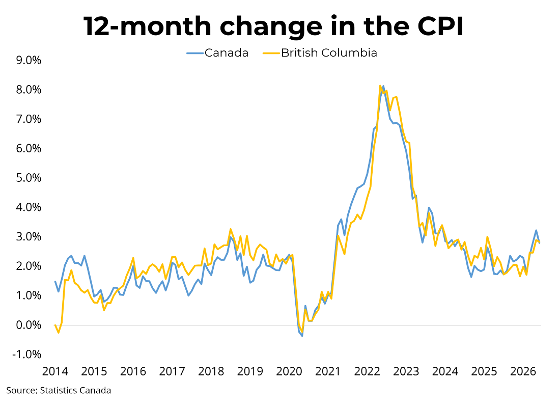
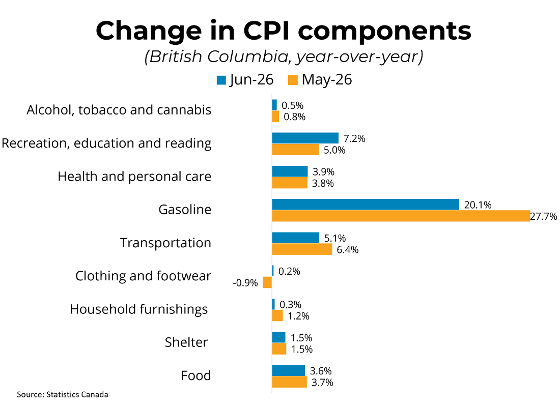
Canadian prices, as measured by the Consumer Price Index (CPI), rose 2.4 per cent on a year-over-year basis in December, following the 2.2 per cent increase in November. On a seasonally adjusted monthly basis, the CPI was up 0.3 per cent in December, equivalent to a 3.7 per cent increase on an annualized basis. The CPI ex-gasoline increased by 3.0 per cent in December, up by 0.4 points from the previous month. Additionally, food prices increased by 6.2 per cent year-over-year, driven by base-year effects from last year’s tax break on restaurant food and continued acceleration in grocery prices. In BC, consumer prices rose 1.7 per cent year-over-year in December, down 0.5 points from November’s increase. The Bank of Canada's preferred measures of median and trimmed inflation, which strip out volatile components, fell to 2.5 and 2.7 per cent year-over-year, respectively. 
 
Much of the upward pressure in December’s CPI print was a base-year effect from last year’s GST/HST holiday on several aggregates, counteracted by larger declines in gasoline prices. Nonetheless, 3-month annualized core inflation cooled to about 1.65 per cent, its lowest level since Spring of 2024, and falling below the midpoint of the Bank of Canada’s threshold. Looking ahead, we expect a rate-hold from the Bank next week as they further evaluate Canada’s economic growth in the final quarter relative to their most recent projections.

Read

Vancouver, BC – January 19, 2026. The Association of Interior REALTORS® (AOIR), in partnership with the British Columbia Real Estate Association (BCREA), is renewing calls for the federal government to exempt several major ski resort communities in the province from 2022’s Prohibition on the Purchase of Residential Property by Non-Canadians Act (also known as the Foreign Buyer Ban).

Under current federal regulations, the Foreign Buyer Ban applies to areas designated by Statistics Canada as Census Metropolitan Areas (CMAs) or Census Agglomerations (CAs). In BC’s Interior, this classification captures nine communities and their surrounding regions. While the legislation aims to curb foreign speculation in major population centres, using CMA and CA boundaries as the determining factor has inadvertently swept up a number of geographically distinct areas.

Specifically, the Foreign Buyer Ban has caused unintentional economic difficulties for some ski communities. In already challenging market conditions, preventing foreign investment in tourism-focused areas is a needless hindrance. Yet despite federal awareness of this issue, the government has been slow to act.

“Another year has gone by and we’ve yet to see any action on this,” said AOIR Director of Government Relations and Communications Seth Scott. “The Interior has some of the province’s most important tourism regions and most popular ski hills. Homes on these mountains serve a different purpose than those in the centre of communities. With another ski season underway, now is the time for government to step up with an exemption and keep these areas economically viable in an already challenged economy.”

Currently, the Foreign Buyer Ban doesn’t encompass other large BC ski resort areas and municipalities, including Whistler and Big White, or other ski communities outside the province, such as Mont Tremblant.

“This is a matter of fairness and consistency,” said BCREA Senior VP of Government Relations, Marketing & Communications Trevor Hargreaves. “Including some ski resort areas and excluding others simply by chance really isn’t good policy making. Providing an exemption for all ski communities in BC is a simple fix and the right thing to do. This is an urgent issue, and it’s one that Canada’s Minister of Housing and Infrastructure, Gregor Robertson, should get to work on fixing immediately.”

 AOIR and BCREA are urging Housing, Infrastructure and Communities Canada as well as the Canada Mortgage and Housing Corporation to issue a regulatory exemption for Sun Peaks, Apex Mountain, SilverStar, and similar Interior ski resort areas as soon as possible.

Read

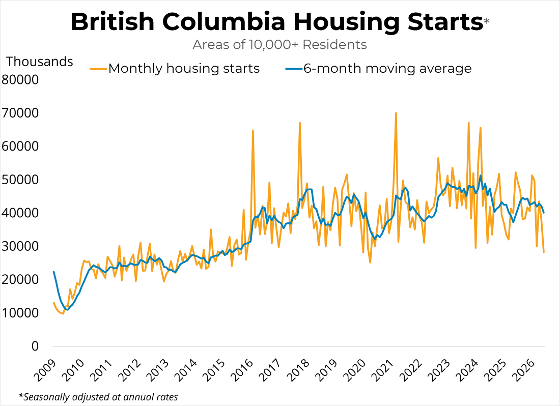
Canadian housing starts increased 11 per cent from the previous month, totaling 282,439 units in December at a seasonally adjusted annual rate (SAAR).Starts were up 21 per cent from the same month last year (SAAR).  In areas with 10,000 or more residents, single-detached housing starts decreased by 14 per cent year-over-year, while multi-family and other starts increased by 35 per cent compared to December 2024. 

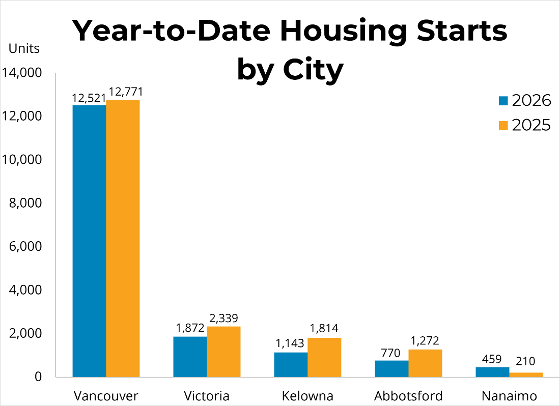
In areas of British Columbia with 10,000 or more residents, starts were up by about 2 per cent from last December to 39,189 units (SAAR). In these urban areas, single-detached starts increased by 4 per cent, while multi-family starts rose by 1 per cent year-over-year. In 2025, year-over-year starts were up by 80 per cent in Abbotsford and 16 per cent in Victoria, but down by 56 per cent in Nanaimo, 31 per cent in Kelowna, and 3 per cent in Vancouver.

Read
Categories:   Albion, Maple Ridge Real Estate | April 2023 Newsletter | April 2024 Newsletter | April 2025 Newsletter | April Newsletter 2022 | Arbutus, Vancouver West Real Estate | August 2021 News | August 2022 Newsletter | August 2023 Newsletters | August 2024 Newsletter | August 2025 Newsletter | Bank | Blueridge NV, North Vancouver Real Estate | Brentwood Park, Burnaby North Real Estate | Brighouse South, Richmond Real Estate | Brighouse, Richmond Real Estate | British Properties, West Vancouver Real Estate | Burke Mountain, Coquitlam Real Estate | Burnaby Lake, Burnaby South Real Estate | Cambie, Vancouver West Real Estate | Canadian Employment | Canadian Inflation | Canyon Heights NV, North Vancouver Real Estate | Canyon Springs, Coquitlam Real Estate | Capitol Hill BN, Burnaby North Real Estate | Central Lonsdale, North Vancouver Real Estate | Central Park BS, Burnaby South Real Estate | Champlain Heights, Vancouver East Real Estate | Citadel PQ, Port Coquitlam Real Estate | Cloverdale BC, Cloverdale Real Estate | Coal Harbour, Vancouver West Real Estate | Collingwood VE, Vancouver East Real Estate | Coquitlam West, Coquitlam Real Estate | COVID-19 Recovery Dashboard | December 2021 Newsletter | December 2022 Newsletter | December 2023 Newsletter | December 2024 Newsletter | Delta Manor, Ladner Real Estate | Downtown NW, New Westminster Real Estate | Downtown VW, Vancouver West Real Estate | Downtown, Vancouver West Real Estate | Dunbar, Vancouver West Real Estate | Eagle Harbour, West Vancouver Real Estate | East Burnaby, Burnaby East Real Estate | East Newton, Surrey Real Estate | East Richmond, Richmond Real Estate | Fairview VW, Vancouver West Real Estate | False Creek, Vancouver West Real Estate | February Newsletter 2022 | February Newsletter 2023 | February Newsletter 2024 | February Newsletter 2025 | Forest Hills BN, Burnaby North Real Estate | Fraser VE, Vancouver East Real Estate | Fraserview NW, New Westminster Real Estate | Fraserview VE, Vancouver East Real Estate | GDP | Grandview VE, Vancouver East Real Estate | Grandview Woodland, Vancouver East Real Estate | Greentree Village, Burnaby South Real Estate | Hamilton RI, Richmond Real Estate | Hamilton, Richmond Real Estate | Hastings, Vancouver East Real Estate | Highgate, Burnaby South Real Estate | House Marketing | Housing Starts | Interest Rate | Ironwood, Richmond Real Estate | January Newsletter 2022 | January Newsletter 2023 | January Newsletter 2024 | January Newsletter 2025 | July 2021 Newsletter | July 2022 Newsletter | July 2023 Newsletter | July 2024 Newsletter | July 2025 Newsletter | June 2022 Newsletter | June 2023 Newsletter | June 2024 Newsletter | June 2025 Newsletter | Killarney VE, Vancouver East Real Estate | Kitsilano, Vancouver West Real Estate | Knight, Vancouver East Real Estate | Letter From The Heart | Lions Bay, West Vancouver Real Estate | Lower Lonsdale, North Vancouver Real Estate | Maillardville, Coquitlam Real Estate | Main, Vancouver East Real Estate | March Newsletter 2022 | March Newsletter 2023 | March Newsletter 2024 | March Newsletter 2025 | May 2022 Newsletter | May 2023 Newsletter | May 2024 Newsletter | May 2025 Newsletter | Meadow Brook, Coquitlam Real Estate | Metrotown, Burnaby South Real Estate | Mount Pleasant VE, Vancouver East Real Estate | Mount Pleasant VW, Vancouver West Real Estate | New Horizons, Coquitlam Real Estate | Newsletter November 2021 | North Coquitlam, Coquitlam Real Estate | North Vancouver Real Estate | November 2021 Newsletter | November 2022 Newsletter | November 2023 Newsletter | November 2024 Newsletter | November Newsletter 2021 | October 2021 Newsletter | October 2022 Newsletter | October 2023 Newsletter | October 2024 Newsletter | Pebble Hill, Tsawwassen Real Estate | Pictures and thoughts to share | Point Grey, Vancouver West Real Estate | Quay, New Westminster Real Estate | Queen Mary Park Surrey, Surrey Real Estate | Queensborough, New Westminster Real Estate | Quilchena, Vancouver West Real Estate | Richmond Real Estate | S.W. Marine, Vancouver West Real Estate | Sapperton, New Westminster Real Estate | September 2021 News | September 2022 Newsletter | September 2023 Newsletter | September 2024 Newsletters | september 2025 Newsletter | Silver Valley, Maple Ridge Real Estate | Simon Fraser Univer., Burnaby North Real Estate | Sold listings | South Granville, Vancouver West Real Estate | South Marine, Vancouver East Real Estate | South Slope, Burnaby South Real Estate | South Surrey White Rock Real Estate | Squamish Real Estate | Steveston South, Richmond Real Estate | Sullivan Heights, Burnaby North Real Estate | The Crest, Burnaby East Real Estate | Tsawwassen Central, Tsawwassen Real Estate | University VW, Vancouver West Real Estate | Upper Eagle Ridge, Coquitlam Real Estate | Uptown NW, New Westminster Real Estate | vancouver island Real Estate | Vancouver Real Estate | Victoria VE, Vancouver East Real Estate | Victoria VE, Vancouver West Real Estate | WALL CENTRE FALSE CREEK, Vancouver West Real Estate | West End VW, Vancouver West Real Estate | Westwood Plateau, Coquitlam Real Estate | Whalley, North Surrey Real Estate | Whalley, Surrey Real Estate | Willoughby Heights, Langley Real Estate | Yale - Dogwood Valley, Vancouver West Real Estate | Yaletown, Vancouver West Real Estate | Yel | Yelllow Newsletter July 2022 | Yellow Newletter December 2021 | Yellow Newletter June 2022 | Yellow Newsletter | Yellow Newsletter April 2022 | Yellow Newsletter April 2023 | Yellow Newsletter April 2024 | Yellow Newsletter April 2025 | Yellow Newsletter August 2021 | Yellow Newsletter August 2022 | Yellow Newsletter August 2023 | Yellow Newsletter August 2024 | Yellow Newsletter August 2025 | Yellow Newsletter December 2021 | Yellow Newsletter December 2022 | Yellow Newsletter December 2023 | Yellow Newsletter December 2024 | Yellow Newsletter February 2022 | Yellow Newsletter February 2023 | Yellow Newsletter February 2024 | Yellow Newsletter February 2025 | Yellow Newsletter January 2022 | Yellow Newsletter January 2023 | Yellow Newsletter January 2024 | Yellow Newsletter January 2025 | Yellow Newsletter July 2022 | Yellow Newsletter July 2023 | Yellow Newsletter July 2024 | Yellow Newsletter July 2025 | Yellow Newsletter June 2022 | Yellow Newsletter June 2023 | Yellow Newsletter June 2024 | Yellow Newsletter June 2025 | Yellow Newsletter March 2022 | Yellow Newsletter March 2023 | Yellow Newsletter March 2024 | Yellow Newsletter March 2025 | Yellow Newsletter May 2022 | Yellow Newsletter May 2023 | Yellow Newsletter May 2024 | Yellow Newsletter May 2025 | Yellow Newsletter November 2021 | Yellow Newsletter November 2022 | Yellow Newsletter November 2023 | Yellow Newsletter November 2024 | Yellow Newsletter October 2021 | Yellow Newsletter October 2022 | Yellow Newsletter October 2023 | Yellow Newsletter October 2024 | Yellow Newsletter October, 2021 | Yellow Newsletter September 2021 | Yellow Newsletter September 2022 | Yellow Newsletter September 2023 | Yellow Newsletter September 2024 | Yellow Newsletter September 2025
Reciprocity Logo The data relating to real estate on this website comes in part from the MLS® Reciprocity program of either the Greater Vancouver REALTORS® (GVR), the Fraser Valley Real Estate Board (FVREB) or the Chilliwack and District Real Estate Board (CADREB). Real estate listings held by participating real estate firms are marked with the MLS® logo and detailed information about the listing includes the name of the listing agent. This representation is based in whole or part on data generated by either the GVR, the FVREB or the CADREB which assumes no responsibility for its accuracy. The materials contained on this page may not be reproduced without the express written consent of either the GVR, the FVREB or the CADREB.